Why IDIOM? |
  
|
Why IDIOM? |
|
IDIOM develops and licenses business friendly decision-making software that automates business policy on a large scale, making systems more agile and more transparent, while reducing development cost, risk, and time.
To be an agile business, robust flexibility must be built into the very heart of its automated systems – flexibility which can be controlled ‘hands-on’ by the relevant business owners to ensure 100% alignment between business strategy and its supporting systems. IDIOM’s unique approach to ‘robust flexibility’ has empowered business owners and extended business agility for customers around the world in local/state/central government, insurance/superannuation/finance, health admin/clinical health, logistics and utilities.
Why business decisions are crucial.
Decisions are the critical mechanism by which we choose one action from the set of all possible actions. The purpose of decision making is to select the action that is most beneficial to the decision maker in a given situation. A decision is 'made' when we resolve all of the available data into a single definitive outcome - a decision cannot be multi-valued, ambiguous or tentative.
The derivation of the decision outcome is achieved by applying an organisation’s discipline, knowledge and experience to the specific problem or opportunity that is described by the available data. It is the essence of this discipline, knowledge and experience that is captured in IDIOM Decision Models and which most closely defines the unique character of any business.
We use the term ‘policy’ to describe the corporate prescription for decision making that results from applied ‘discipline, knowledge, and experience’. The concept of policies can be extended to include negotiated arrangements (contracts) and imposed rules (regulations). Together, these policies define how an organisation acts and responds in the world in which it operates. The IDIOM Decision Manager is a tool which is able to codify and capture, test, and then automatically deploy, the full range of business policies including complex policies on a national scale.
Increasingly, the IDIOM Decision Manager is also being used to actually develop policy. When partnered with the IDIOM Decision Manager Workbench, it can be used to develop and test new policy options, which when proven, can be inserted directly into systems as an executable, while at the same time being formalised into the organisations auditable policy statements and commitments.
IDIOM’s decision models are formal models of the decision making that a policy requires for it to be given effect within computer systems, so that an IDIOM Decision Model is a practical and fully executable manifestation of business policy.
What do we mean by a 'decision'?
Decision Defn: A single definitive outcome that is the result of applying business knowledge to relevant data for the purpose of positively directing the activity of the business.
The desire or need to regulate and control system responses to give a zero touch process is ensuring that decisioning is becoming a core function of many modern systems.
In these systems decisioning drives the discovery of data and its relevance to the business - the need for the decision drives the need for the data. And because the decision outcome predicates the process response, it also implicitly drives the process definition.
Businesses do not make a decision merely because they have available data, nor do they act without making a decision. Decisions are clearly identifiable as the heart of any automated systems response.
If decisions are core drivers of the data and process elements of a system, they are also drivers of other decisions. For instance, the decision to accept insurance business depends in turn on decisions regarding the customer, the insured risk, price, underwriting terms, etc. Each decision can also depend on other decisions until a tree structured model of decisions is formed - the decision model. The decision model does for decisions what the data model does for data - a powerful abstraction that aids visibility and understanding.
Decision Model Defn: An ordered assembly of decisions that creates new and proprietary information to definitively determine an optimal course of action for the business.
The systemisation of decision discovery, definition, and deployment, including the execution of deployed decisions, is the basis of the new discipline of 'decisioning'.
Decisions and Business Rules
Decisions can be complex and multi-layered, and are underpinned by business rules. Business rules are used to determine the decision outcome for each specific set of circumstances; they specify the details underlying the business decision. Many rules may be required to define a single decision and to cover all circumstances. Figure 1-1 gives some examples of the business rules underlying decisions.
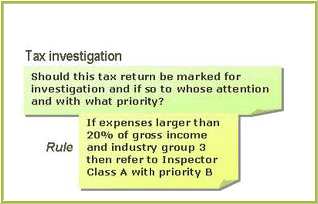
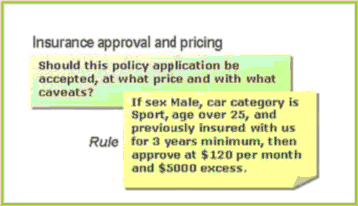
Figure 1-1: Examples of decisions and their corresponding business rules
Business rules in today's systems.
Today's systems manage data and process. They contain, but usually do not understand or manage, the rules that underlie decisions. Yet a high proportion of maintenance changes result from changes to business rules. These maintenance changes incur cost and delay before any benefit can be gained from implementing the new rules. To be competitive, businesses need:
•Applications that respond quickly to changes in business conditions. |
•Quick and direct control over the rules that their applications use to make decisions. |
A new approach: Focus on Business rules.
In an approach that focuses on business rules, IDIOM recognizes decisions as unique and critical elements of the 'personality' of the business and builds systems that explicitly understand and manage the rules underlying these decisions. The benefits of this decision-centric rules approach are:
•An increase in the business's ability to implement timely changes in policy and operation. |
•A matching decrease in the cost of implementing changes. |
•A clearer system architecture leading to improvements in quality and cost. |